and Humans: AI Adoption Diagnostics
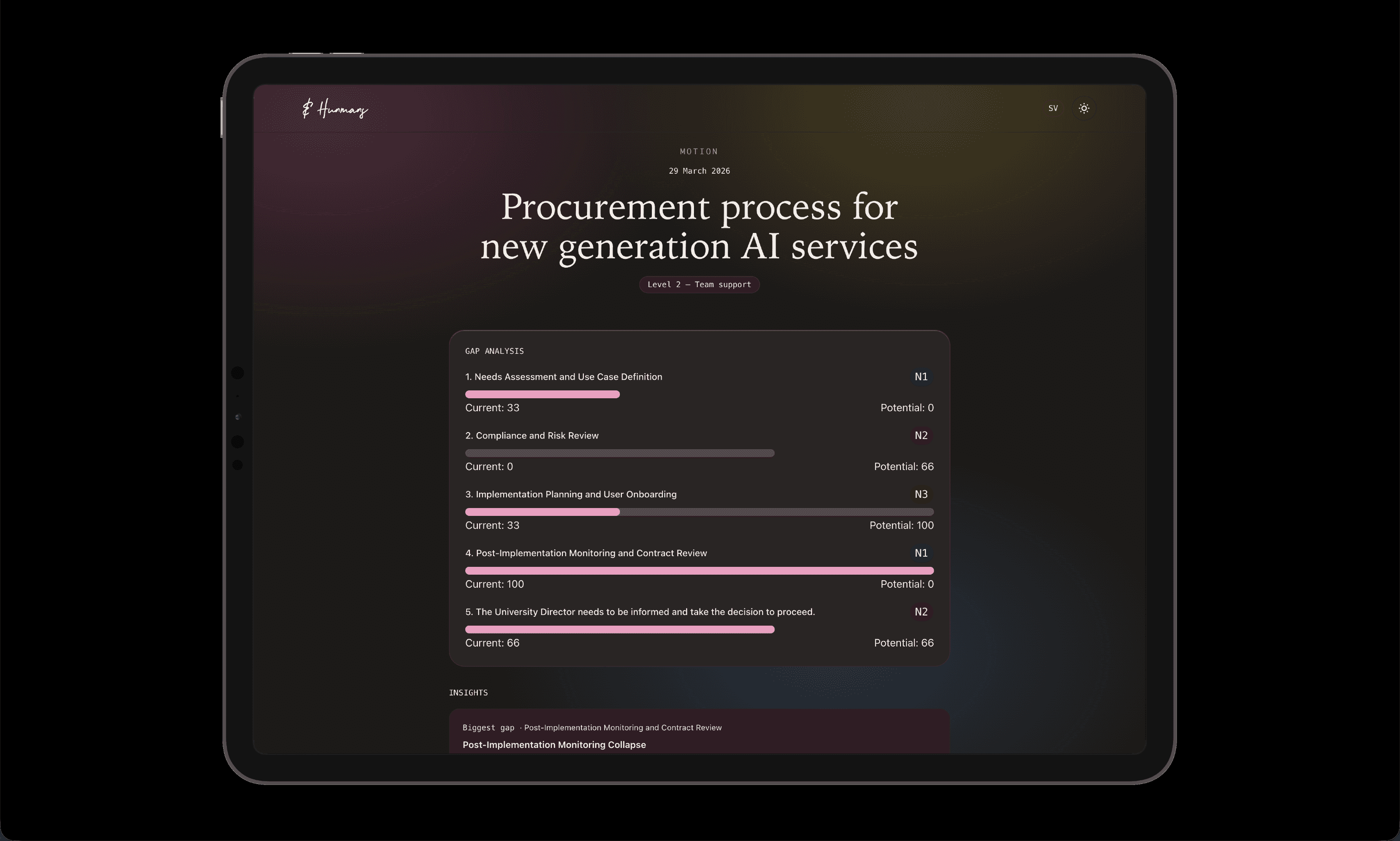
Four free, no-login instruments that move an organisation from abstract AI ambition to a concrete, grounded plan — one role, one process, one team at a time. Motion, shown here, turns a process a team owns into a gap map of where AI fits and where it deliberately should not.
- 4
- Diagnostics in the suite
- ~15 min
- From a process to a gap map
- No login
- Save & share by link
Overview
SECTION 01Problem
Most organisations talk about AI adoption in the abstract — a strategy slide, a maturity score, a vendor demo. None of it touches the actual work. Leaders are left with a number and no next move, and teams are handed tools with no sense of where they genuinely help versus where a human must stay in the loop. The conversation rarely gets specific enough to act on.
Solution
A suite of four lightweight diagnostics at andhumans.se/tools, each grounded in a real unit of work rather than a survey. You describe a role, a process, an organisation, or current usage; the tool maps it, scores it, and hands back a concrete artefact — a gap map, an insight, a level — that a team can act on the same afternoon. Free, bilingual (EN/SV), no account required, results saved and shared by link.
The Suite: Four Instruments
SECTION 02The tools are deliberately scoped — each answers one question at one altitude, from the individual up to the whole organisation. Together they form a ladder: understand the person, then the process, then the organisation, then what is really being used.
Cognition · the individual
“What kind of thinker do you want to become?” Personal role exploration through three research-grounded perspectives.
Motion · the team
“Pick a process your team owns. See where AI fits — and where it doesn’t.” A 15-minute workshop that ends in a gap map.
Position · the organisation
“Where does your organisation stand relative to others?” AI maturity mapped through sixteen statements.
Adoption · the reality
“How adopted is AI in your organisation — really?” Actual usage measured with an aiNPS and tracked over time.
Motion: From a Process to a Gap Map
SECTION 03Motion is the worked example pictured in the hero. Instead of asking a team to rate themselves, it asks them to bring a process they actually own — “recruitment of PhD candidates”, “the budget process in finance”, “procurement of new-generation AI services” — and walks it through five moves in about fifteen minutes:
Describe
The team writes the process in free text. If the context is thin, the model asks a follow-up question or two before continuing — no rigid form to fill in.
Map
Claude generates two to eight process steps as a first draft. The team edits, reorders, adds and removes until it matches how the work really runs — the map is theirs, not the model’s.
Reflect
Three quick questions on three themes: what takes time without payback, what they would happily hand off, and what they long for. This grounds the analysis in lived friction, not theory.
Analyse
Each step gets a Current score (how much AI supports it today) and a Potential score (how much it could), on a 0 / 33 / 66 / 100 scale. The distance between them is the gap — the pink and purple bars in the report.
Reimagine
In parallel, Motion drafts an AI-native version of the same process: a short vision plus reimagined steps, each tagged as AI, Human or Together, with human gates preserved where they belong.
The Borås Value Triangle
For public-sector, municipal and higher-education processes, each step is placed on the Borås Value Triangle — the N1 / N2 / N3 badges in the report. They name the kind of value on offer, not just its size:
- N1 — Individual support (Level 1): AI helps a person with a discrete task. Lower potential.
- N2 — Team support (Level 2): AI augments coordination, quality and workflow across a team.
- N3 — Transformative (Level 3): AI reimagines the process or its outcome altogether. Highest potential.
Insights, not just bars
The report closes with three named insights, each tied to a specific step rather than the whole process — a Biggest gap (where current and potential diverge most), a Quick win, and a Strategic warning. In the example shown, the biggest gap is a “Post-Implementation Monitoring Collapse”: the process front-loads effort and lets the back end fall away.
Keeping the Analysis Honest
SECTION 04A generic LLM will happily produce confident, sector-blind advice. Motion is built to avoid that. Before it writes the gap analysis, the analyse step pulls sector-specific grounding from Field Kit — the in-house research database of trends, papers and regulations — and falls back to a live web query (Perplexity) when that grounding is thin. Relevant signals are fed into the prompt so the output reflects the actual regulatory and technological context of, say, public procurement rather than a generic template.
The model itself is Claude Haiku 4.5 across the context, steps, reflect, analyse and reimagine endpoints — fast and cheap enough to keep the whole workshop under a few seconds per move, with temperatures tuned per task (lower for structured extraction, higher for reimagining).
Architecture & Stack
SECTION 05Core Technologies
- Next.js 16 (App Router) + React 19 + TypeScript
- Claude Haiku 4.5 via the Anthropic SDK
- Supabase Postgres — saved reports, analytics, rate-limit events
- Field Kit + Perplexity — research grounding
- Framer Motion — the step-by-step flow
- Resend + QR — email the report, share by link
Design Decisions
- No login — results saved anonymously, owned by a private token
- Shareable report URL so a team can keep working from it
- Bilingual EN/SV throughout, copy and analysis
- IP rate-limit guard on every AI route (no auth wall)
- Session cached to localStorage with a 24-hour resume
- Pilot vs public release mode toggled by env flag
Each tool is a self-contained flow under /app with its own API routes, a shared i18n layer, and a saved-report view that renders the same artefact from a stored record. The pipeline is deliberately thin: extract context → generate steps → tailor reflection → analyse with grounding → reimagine, each a single structured model call.
Status
SECTION 06| Aspect | Detail |
|---|---|
| Live | Public at andhumans.se/tools |
| Tools | Cognition · Motion · Position · Adoption |
| Access | Free, no account, save & share by link |
| Languages | English / Swedish |
| Model | Claude Haiku 4.5 (Anthropic) |
The tools are the product arm of and Humans — a way to make a first AI-adoption conversation concrete, for free, before any engagement. Try Motion with a process your team owns and you have a gap map in fifteen minutes.